
Housing.
Sustainability.
Reality.
Brussels, Belgium
A reflection on affordable housing, sustainable construction, climate resilience and implementation.
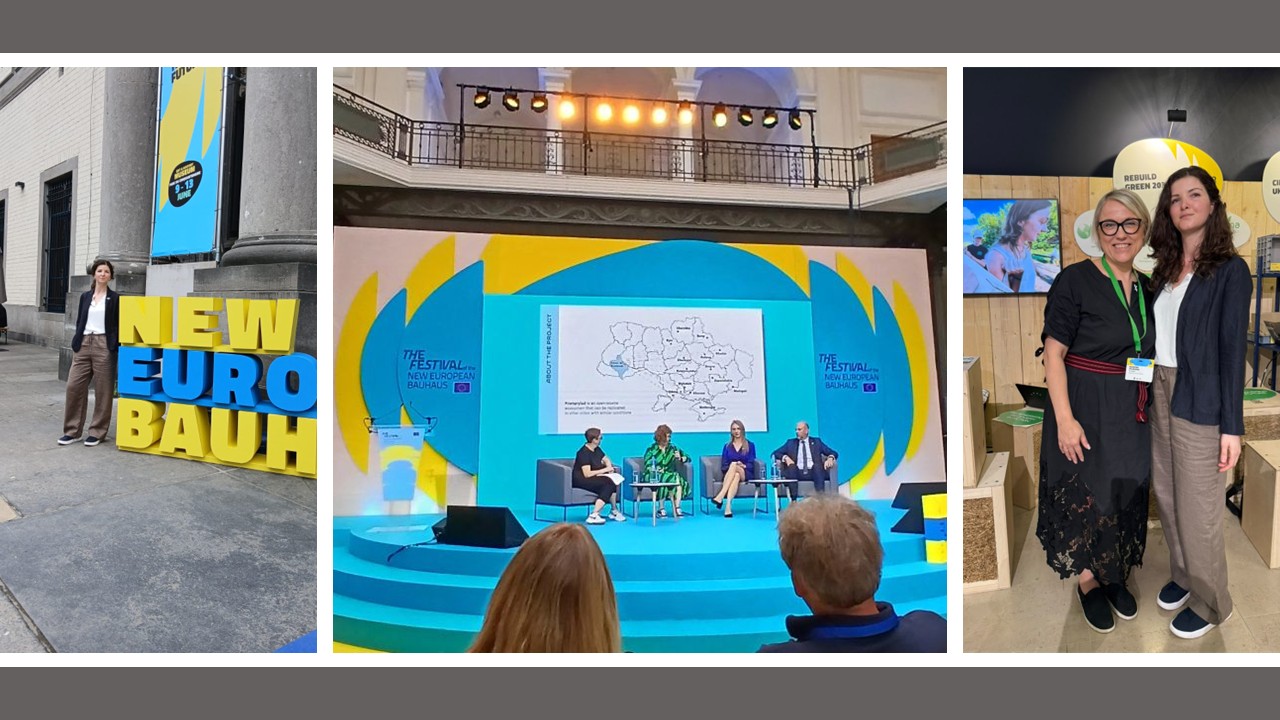
The New European Bauhaus Festival 2026 brought together discussions that are increasingly difficult to separate: affordable housing, sustainability, climate change, construction costs, resilience and the question of how ideas become workable solutions. We went to Brussels to listen, look closely and understand where these issues meet in practice.
Housing is
not substitutable.
During my first year of training as a Real Estate Manager, one sentence from my teacher stayed with me: housing is not substitutable.
I have never forgotten it.
It sounds simple, but it describes something fundamental. A home is not a product that can simply be replaced by another category when supply, price or quality no longer work. People need places to live. They need them to be safe, accessible and financially possible. They need neighbourhoods that function and infrastructure that supports everyday life.
That perspective was very present for me at the New European Bauhaus Festival.
The festival was not only about architecture or aesthetics. Its 2026 programme placed affordable housing and democratic engagement at the centre of a broader discussion about the future of the built environment.
That combination matters. Sustainability cannot be considered separately from whether people can actually afford the result. Climate resilience cannot be separated from the physical places in which people live. And good ideas do not become useful simply because they are technically possible.
The problem is
not one-dimensional.
Europe needs more housing. At the same time, the way we build has to change.
Climate change increases the need for buildings and neighbourhoods that can withstand changing conditions. Energy use and emissions have to be reduced. Materials and construction processes have to become more sustainable. Existing buildings and places need to be considered alongside new construction.
But construction is also expensive. Land, materials, labour, financing, regulation and infrastructure all affect what can ultimately be delivered. A solution can be environmentally convincing and still fail if the people who need housing cannot afford it.
One observation from the festival captured this tension particularly well. In a panel discussion, one of the speakers reflected on the limits of advocacy from an architectural perspective: she could argue for better and more sustainable construction, but ultimately people have to be able to afford it. That is where government becomes necessary.
This was not an argument against sustainability. It was a reminder that sustainable solutions have to operate within economic and institutional reality.
For us, that is one of the most interesting intersections: sustainability, affordability, physical places and the systems required to make change possible.
Sustainable is not
enough on its own.
Sustainability has to work together with affordability, availability and the realities of construction.
That was one of the things I took away from Brussels. The different challenges surrounding the built environment cannot really be separated from each other. Europe needs more housing, while construction is simultaneously expected to reduce emissions, use resources more carefully and respond to a changing climate.
At the same time, construction costs are high. Land, materials, labour, financing, regulation and infrastructure all affect what can actually be delivered. A solution can be environmentally convincing and still fail if the people who need housing cannot afford it.
One observation from a panel at the festival captured this tension particularly well. One of the speakers, speaking from an architectural perspective, pointed out that she could advocate for better and more sustainable construction, but ultimately people have to be able to afford it. That is where government is needed. I understood this as a practical observation rather than an argument against sustainability: ambitions for the built environment have to meet economic and institutional reality.
This is also where the discussion becomes interesting for us. The question is not simply how to design a more sustainable building. It is how sustainable, affordable and resilient solutions can actually be implemented. That involves planning and regulation, financing and procurement, infrastructure and data, as well as the ability of public and private organisations to work together.
Housing is also
a systems question.
Housing is often discussed as a construction problem. It is also a question of systems. Where housing is built affects transport, access to services, energy use and the way communities develop. The condition of existing buildings matters. So does the availability of land, infrastructure and public services.
That is why the discussion around affordable housing at the festival was relevant beyond housing itself. A building does not exist in isolation. Its affordability, energy performance, location, connections and long-term use are influenced by decisions made across several different areas.
If housing is not affordable, a technically excellent building does not solve the underlying problem. If planning processes make necessary projects impossible to deliver, good intentions remain intentions. If public authorities, developers, architects, engineers and communities work from completely different assumptions, implementation becomes harder.
The challenge is therefore not simply to find better materials or better designs. It is to create the conditions in which those solutions can actually be used.
Not everyone
was in Brussels.
Nicolas was not at the festival in person. His perspective nevertheless belongs in this discussion because his work is closely connected to the physical and digital systems behind places and infrastructure.
His background and interests in geospatial information, field data, digital infrastructure and BIM bring another perspective to the question of how places are planned, understood and managed.
Buildings and neighbourhoods generate and depend on information. Where things are, how they are connected, what condition they are in and how they change over time can influence decisions just as much as the design itself.
This is one reason why the discussion cannot stop at architecture. Physical places, data and organisational processes are connected. If better decisions are to be made about housing, infrastructure and resilience, those connections need to be understood.
Technology is not the answer to the housing problem. But reliable information, appropriate digital tools and functioning processes can be part of the conditions under which better decisions become possible.
From ideas
to real conditions.
The festival also connected directly to something we are already interested in: the reconstruction of Ukraine.
At the festival, we met people working around Rebuild Green 2030 and saw how questions around sustainable construction, circular approaches and reconstruction are being brought together. We also met Modulina and had conversations about sustainable building materials and practical approaches to construction.
What interested us was not sustainability as a label. It was the question of how different approaches can work in real projects and under real constraints.
Ukraine makes those constraints particularly visible. Reconstruction cannot happen in a theoretical environment. Housing, infrastructure, materials, financing, planning and local capacity all have to be considered under circumstances that are far from ordinary.
That is one of the reasons we applied to participate in the Rebuild Green Hackathon. We want to work with international experts, contribute what we know and learn from people approaching reconstruction from different disciplines and different contexts.
Most importantly, the Hackathon works with real municipal reconstruction challenges. That matters to us. We are interested in applying knowledge where conditions are real, constraints are visible and the consequences of decisions matter — not only in a conceptual environment or in a bubble.
For me, Ukraine is personal. I am Ukrainian. I am also Norwegian, and Norway is my home.
I want to contribute where I can.
These two perspectives are part of the same motivation. Ukraine is the country I come from. Norway is the country in which I have built my life and my work. Both matter to me.
That is also why questions such as resilience, effective supply and functioning infrastructure are not abstract topics. Stable environments do not happen by themselves. They depend on places that work, organisations that can act and systems that can respond when circumstances change.
Reconstruction makes this particularly visible. But the underlying questions are not limited to Ukraine. They are relevant wherever housing, infrastructure, climate adaptation and public capacity have to work together.
Working with
real constraints.
The conversations in Brussels were one of the reasons we wanted to take the next step and apply for the Rebuild Green Hackathon.
The initiative brings together people from different disciplines around the green reconstruction of Ukraine. Its approach connects sustainable and circular construction with actual municipal reconstruction needs rather than treating reconstruction as a purely theoretical exercise.
That distinction matters to us. We want to exchange with international experts, contribute our own experience and learn from people who approach the same problems from architecture, urban planning, engineering, construction, landscape, financing, digitalisation and other fields.
The Hackathon is particularly relevant because participants work with real challenges from Ukrainian municipalities. That creates a different kind of learning environment. Constraints are not something added afterwards to a concept. They are part of the problem from the beginning.
We are interested in that kind of work: taking knowledge out of the comfortable environment in which it was developed and testing what remains useful when conditions are complex, resources are limited and decisions have consequences.
For us, that is where the connection between the New European Bauhaus discussion and reconstruction becomes concrete.
From sustainable ideas
to workable places.
The New European Bauhaus Festival left us with fewer simple answers, but with a clearer understanding of the questions.
How do we create housing that people can actually afford? How do we make construction more sustainable without losing sight of economic reality? How do we prepare places and infrastructure for changing conditions? And how do public authorities, private organisations and communities create the capacity to turn good ideas into something that works?
These are not questions that can be answered by architecture alone, by technology alone or by policy alone. They require different perspectives to meet and work together.
That is what we took from Brussels: not a single solution, but a stronger interest in the intersection between sustainable places, housing, resilience, data, governance and implementation.
And that is where we want to continue the conversation.